1950's


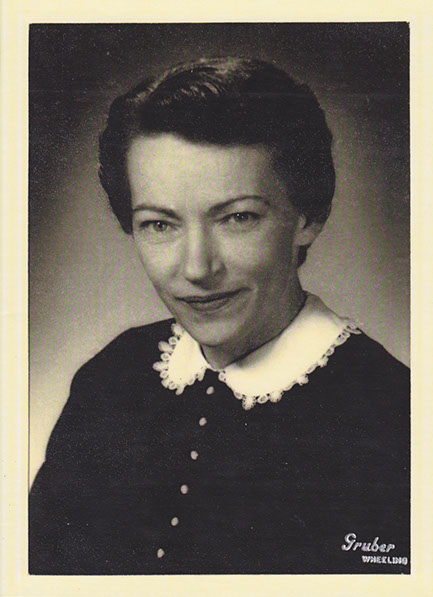




For some time in the 1950's, Jeanne put her Elliott's Commercial College skills to work when she became the assistant to the Wheeling Post Master, landing her this photo-op in the Wheeling News Register.
Jeanne was the Champion for three days on the 1957 live TV program from New York, The Price is Right with Bill Cullen.
Jeanne, host of the daily WWVA radio program, Report to the Women
1958-62
Jean and Bud's family, circa 1950. Pictured L to R are:
Jack Rubins, Mary (Mimi) Sharpe, Jim Hamm (with hat), John Hamm (2) Bud, Jeanne, Bobby Rubins (sitting) Carolyn Rubins (5), Madeline and Johnny Rubins
The Jeanne & Bud Hamm family, 1951
Jim (10) was entering 5th grade at Linsly. John was 3
Jeanne & Jim pictured. Jim's Linsly Final Drill competition, about 19152-3
Bud 's shadow, with his Borsalino hat, in foreground. He loved those hats and purchased a new one in New York from time to time.
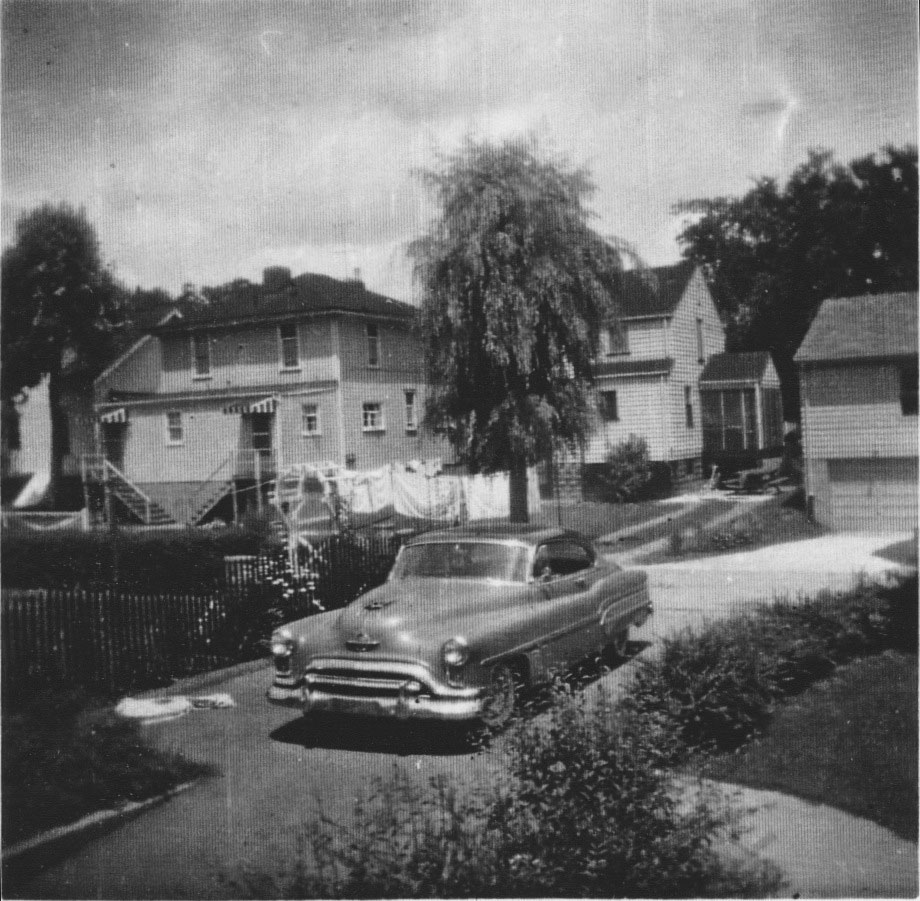
Jeanne & Bud's early 1950's Olds. Bud would purchase a new, used car from his friend, Harry Hesse, when Harry bought his New, New Cars.
<
>
1950's were years of mothering
and career for Jeanne
• Jim entered Linsly Military Inst.
• Jeanne worked for the Postmaster
• Jeanne on The Price is Right
• John entered Linsly in 1958
• Jeanne began her career in Radio
CLICK HERE to Jump to the NEXT DECADE
The following is a link to the YouTube video, made in 1959, narrated by Jeanne's WWVA Radio Co-Host, Lew Clawson. The Video presents the history of Wheeling, WV.

What was happening in Jeanne's World
in
The 1950's - Two Cars in Every Garage
January 14, 1950 - The United States recalls all consular officials from China after the seizure of the American consul general in Peking, now called Beijing. Gunther and Anna Hamm held their wedding rehearsal dinner in 2010 in that same building.
January 17, 1950 - The Brinks robbery in Boston occurs when eleven masked bandits steal $2.8 million from an armored car outside their express office.
June 25, 1950 - The Korean War begins its three year conflict when troops of North Korea, backed with Soviet weaponry, invade South Korea. This act leads to U.S. involvement when two days later, the United States Air Force and Navy are ordered by President Truman to the peninsula. On June 30, ground forces and air strikes are approved against North Korea.
June 27, 1950 - Thirty-five military advisors are sent to South Vietnam to give military and economic aid to the anti-Communist government.
November 26, 1950 - United Nations forces retreat south toward the 38th parallel when Chinese Communist forces open a counteroffensive in the Korean War. This action halted any thought of a quick resolution to the conflict. On December 8, 1950, shipments to Communist China are banned by the United States.
For the first time, the 1950 census indicated a population in the United States over 150 million people. The 14% increase since the last census now showed a count of 150,697,361.
March 29, 1951 - Julius and Ethel Rosenberg were found guilty of conspiracy of wartime espionage and sentenced to death. They were executed June 19, 1953.
September 4, 1951 - The inauguration of trans-continental television occurs with the broadcast of President Truman's speech at the Japanese Peace Treaty Conference in San Francisco.
February 14, 1952 - The 1952 Winter Olympics games open in Helsinki, Finland with thirty participating nations. During these games, the first triple jump in figure skating history is performed by Dick Button, who won one of the four gold medals gained by U.S. athletes.
November 1, 1952 - At Eniwetok Atoll in the Pacific Ocean, the first hydrogen bomb, named Mike, is exploded. On January 7, President Harry S. Truman announces the development of the H-Bomb.
November 1952 - General Dwight D. Eisenhower, a newcomer to politics, but popular due to his role in winning World War II as European commander, gains as easy victory over Democratic challenger Adlai E. Stevenson.
July 27, 1953 - Fighting ceased in the Korean War. North Korea, South Korea, the United States, and the Republic of China sign an armistice agreement.
August 19, 1953 - The United States CIA assists in the overthrow of the government in Iran, and retains the Shah Mohammad Reza Pahlavi to the throne.
October 30, 1953 - The Cold War continues in earnest when President Dwight D. Eisenhower approves a top secret document stating that the U.S. nuclear arsenal must be expanded to combat the communist threat around the world.
December 30, 1953 - The first color televisions go on sale.
February 23, 1953 - The first large scale vaccination of children against polio begins in Pittsburgh, Pennsylvania.
April 22, 1954 - Joseph McCarthy begins televised Senate hearings into alleged Communist influence in the United States Army. Later this year, on December 2, the U.S. Congress votes to condemn Senator McCarthy for his conduct during the Army investigation hearings.
May 17, 1954 - Racial segregation in public schools is declared unconstitutional by the United States Supreme Court in Brown vs. the Board of Education. The ruling of the court stated that racial segregation violated the 14th Amendment's clause that guaranteed equal protection. The Monroe School in Topeka, Kansas had segregated Linda Brown in its classes.
September 8, 1954 - In Bangkok, Thailand, the Southeast Asia Treaty Organization is formed by the U.S., Great Britain, Australia, New Zealand, France, the Philippines, Pakistan, and Thailand, creating a mutual defense pact.
In 1954, Ray Kroc founds the idea for the McDonald's corporation, agreeing to franchise the idea of Dick and Mac McDonald, who had started the first McDonald's restaurant in 1940 and had eight restaurants by 1954. Kroc would incorporate the entity on March 2, 1955 and open his first franchise on April 15 in Des Plaines, Illinois. He would buy out the McDonald's brothers in 1961.
February 12, 1955 - The United States government agrees to train South Vietnamese troops.
May 31, 1955 - The Supreme Court of the United States orders that all public school be integrated with "deliberate speed."
July 17, 1955 - Disneyland, the brainchild of Walt Disney, whose father had worked at previous world's fairs and inspired his son to build the iconic Magic Castle and other exhibits, opens in Anaheim, California, with the backing of the new television network, ABC. Disneyland California remains today as one of the greatest theme park capitals of the world and some say is second only to his second park built some years later on the other side of the country, Disney World Florida.
December 1, 1955 - Rosa Parks, an African American seamstress, refuses to give up her seat on the bus to a white man, prompting the boycott and NAACP protect that would lead to the declaration that bus segregation laws were unconstitutional by a federal court.
December 5, 1955 - The two largest American labor unions, the American Federation of Labor and the Congress of Industrial Organizations, merge to form the AFL-CIO, boasting membership of fifteen million.
March 12, 1956 - One hundred and one congressmen from Southern states call for massive resistance to the Supreme Court ruling on desegregation.
June 29, 1956 - Interstate highway system begins with the signing of the Federal-Aid Highway Act. The interstate highway system would enable quick and efficient travel for business and leisure travelers and make destinations like Disneyland and the National Park system more easily connected to the urban population centers of the USA.
September 25, 1956 - The first transatlantic telephone cable began operation.
October 8, 1956 - Dan Larsen pitches the first no-hitter, a perfect game, in post-season baseball history when his New York Yankees best the Brooklyn Dodgers in the 5th game of the 1956 World Series.
January 21, 1957 - President Dwight D. Eisenhower is inaugurated for his second term in office.
April 29, 1957 - U.S. Congress approves the first civil rights bill since reconstruction with additional protection of voting rights.
September 4, 1957 - National Guard called to duty by Arkansas Governor Orval Faubus bar nine black students from attending previously all-white Central High School in Little Rock, Arkansas. He withdrew the troops on September 21 and the students were allowed entrance to class two days later. A threat of violence caused President Eisenhower to dispatch federal troops to Little Rock on September 24 to enforce the edict.
December 6, 1957 - The first attempt by the United States to launch a satellite into space fails when it explodes on the launchpad.
Gordon Gould, an American physicist, invents the laser, It would take him until 1977 to win a protracted legal battle over patent rights, and he did not start receiving royalties on his work until 1988. Gould was elected to the National Inventors Hall of Fame in 1991.
January 31, 1958 - Explorer I, the first U.S. space satellite, is launched by the Army at Cape Canaveral. It would discover the Van Allen radiation belt.
April 17, 1958 - The first major world's fair since the end of World War II opens in Brussels, Belgium and evokes a Cold War debate between the pavilions of the Soviet Union and the United States. Their competing visions of the world vie for the attention of the over 41 million visitors to the event, also noted for the Atomium atom molecular structure that stood as the fair's theme.
July 8, 1958 - The Lituya Bay, Alaska earthquake registers 7.5 on the Richter scale, producing a landslide that caused a mega-tsunami with a 520 meter high wave. Only two people were killed in the incident, due to the desolate nature of the area involved. The wave dissipated when reaching the open sea.
December 10, 1958 - Jet airline passenger service inaugurated in the United States by National Airlines with a flight between New York City and Miami, Florida.
January 3, 1959 - Alaska is admitted to the United States as the 49th state to be followed on August 21 by Hawaii.
January 7, 1959 - The United States recognizes the new Cuban government under rebel leader Fidel Castro. Castro becomes the Premier of Cuba on February 16.
April 9, 1959 - NASA selects the first seven military pilots to become the Mercury Seven, first astronauts of the United States. The Mercury Seven included John Glenn, Scott Carpenter, Gordon Cooper, Gus Grissom, Wally Schirra, Alan Shepherd, and Deke Slayton.
April 25, 1959 - The St. Lawrence Seaway is opened along the Canada and United States borders, allowing increased ship traffic between the Atlantic Ocean and the Great Lakes.
February 22, 1959 - The Daytona 500 stock car race is run for the first time with Lee Petty taking the first checkered flag.
September 26, 1959 - President Dwight D. Eisenhower hosts Soviet premier Nikita Khrushchev at his farm in Gettysburg, Pennsylvania during the first visit of any Soviet Union leader to the United States.
CLICK HERE to Jump to the NEXT DECADE